FLAT BRANCH TOWNSHIP
(Shelby County)


FLAT BRANCH TOWNSHIP
(Moultrie County)

BIOGRAPHICAL SKETCHES


FLAT BRANCH TOWNSHIP. (SHELBY COUNTY.)

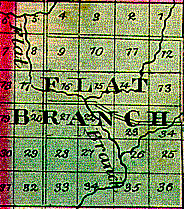
THIS is one of the north-eastern townships of Shelby county. It derived its name from the stream which drains the greater portion of its surface. It comprises the Congressional township 13, range two east; and has an area of thirty-six square miles , or 23,040 acres.

Boundary Roads, Topography, etc. -- Flat Branch is bounded on the north by Moawequa, east by Penn and Pickaway, south by Rural township, and west by Christian county. It is well supplied with good roads and bridges. Illinois Central railroad crosses a por tion of the northwest corner of sections six and seven. The surface is mostly a level prairie, except in the region adjacent to Flat Branch, where the surface is gently undulating. Originally there was considerable timber along the water courses.

Drainage, Timber, Son, Productions, etc. -- This township is admirably drained by the Flat Branch and its numerous tributaries; the Flat Branch meanders through the central portion of the township, furnishing abundant water for stock purposes. Near Flat B ranch there is some gently sloping and very fertile land, with a growth mostly of red and American elm, black walnut, shell bark, and pignut hickory, mulberry, bur oak, cornus, hazel, buckeye, red oak, prickly ash, and grape vines. There are occasional sp ots with a luxuriant growth of Impatiens fulva and I. pallida including a rich moist son. The son is a dark rich loam. The staple productions are corn hay, wheat, oats, potatoes, and all kinds of garden vegetables grow luxuriantly. Grazing and stock-raisi ng is also carried on here quite extensively.

Early Settlers. -- The pioneer settler was Robert Tolly. He came here in the spring of 1828, and improved a small tract of land and built a cabin on section 12, where he resided until his death, which occurred in the year 1844. Mr. Tolly was a native of K entucky. On arriving at the age of manhood, he removed to Madison county, Illinois, where he spent several years prior to becoming a citizen of Shelby county. He was a man of considerable intelligence, and was a useful and honored citizen. In 1830 William Smith, Moses Smith, Joseph Brimhall, and Michael Thornton, with their families, came to and settled near where Mr. Tolly resided. They purchased no land, but " squatted." However, they erected cabins and gained their subsistence largely by hunting and tr apping, and tilling small patches of land. These families all came from the southern part of the state. They remained here only about five or six years, and then migrated to Arkansas. William Smith was a Baptist preacher. Isaac Romine, a son-in-law of Smi th, settled here about the same time. Jonathan Denton now one of the oldest residents of the township, came here in 1832. He lived for two years in the family of Robert Tolly, and then married Miss Catherine Armstrong, and built a cabin on section fourte en, in the year 1834; here he improved a farm. He still resides within a short distance of where he settled. Mr. Denton is a native of Barren county, Kentucky. His father, Jonathan Denton, Sr., was one of the early settlers of Montgomery county, Illinois, and lived near the village of Zanesville; it was there that Jonathan, Jr.'s boyhood was principally spent. In the fall of 1832, Solomon Scribner, then a single man, settled on section 12, near the Tully settlement; erected a cabin, and made an improvemen t. In the early part of the year 1833, Mr. Scribner married Lucinda Smith. This was the first marriage which occurred in this township. After residing here a few years, Mr Scribner and family moved to Arkansas. The second marriage was that of Jonathan Den ton to Catherine Armstrong, in 1834.

The first death was that of Joseph Eldridge in 1828. He came into the Tolly neighborhood to settle and was attacked with milk sickness and died in Robert Tolly's house.

Elias Armstrong became a resident here in about 1832. For four years previously he had lived in what is now Pickaway township. He bought the improvements in Flat Branch of Daniel Agles, who made a settlement just north of where the Baptist church n ow stands, in 1829 or 1830. Agles was a German, and after disposing of his place he returned to the settlement on Beck's Creek, in this county, where he had formerly resided. William Armstrong settled on the Gordon Branch, near Denton's, inl834 or '35. He was a young married man, and only lived about two years after his marriage. James Tully, a brother of Robert, located here in 1833, on section 13. He was also a native of Kentucky, and was principally raised in Madison county, Illinois, five miles south of Edwardsville. He built the first frame house in this township, and lived here until 1870, when he moved to Okaw Township; however, before coming to Shelby county he had lived with his parents, Cornelius Tolly and wife, in the counties of St Clair, Madi son, and Montgomery. Other old settlers were Stewart Fisher and Samuel Watkins and their families. They located lands in the south-eastern part of the township. Cornelius Tolly lives near the Baptist church. He is a son of Robert Tolly, and has lived in F lat Branch upwards of half a century.

The Gordon family settled about half a mile above the mouth of Gordon Creek, on the north side, in 1833, This creek received its name from that family. They lived here only a few years when they moved to another part. They buried a child near their cabin in a lonely grave on the bank of the creek. That was the second person buried in the township.

Page 281


W. P. Sellers is one of the old residents and lives on section 16, south side of the Flat Branch, and his wife is said to be the oldest resident of the township. The oldest man in the township is W. R. Clark. He lives on section 21, and is also one of the old settlers.

William Chadwick was one of the early settlers in the south-east part of the township. He lived on section 26. He subsequently moved a few miles north, and improved a large farm in sections 13, 14, 23, and 24, where he lived until his death in 1876 . Mr. Chadwick was an enterprising and public-spirited man, and was ever ready to lend a helping hand to every laudable object that was calculated to benefit the locality in which he resided. He held the office of justice of the peace for several years, a nd other township offices. He has a native of the State of New York.

Willis and John Virden, two brothers, are also among the early settlers. Willis lives on section 15. He as born in the south part of Shelby county in 1825. His father, James Virden, was one of the first settlers of that section of the county. He wa s a native of Georgia. In 1842 he moved to Flat Branch, and located on section 10. He died in the year 1859. In 1840 a Scotchman by the name of John McKenzie made an improvement on section 2, now better known as the widow Howse's place. After selling this place to Mr. Howse, he began another improvement on section 10, and subsequently moved to Texas. Prior to 1840 Levi Casey improved a farm on section 10.The place is now owned by R. H. Groom. Mr. Casey was a son of Levi Casey, sen., who settled on Robinso n's Creek, in another portion of the county, in 1824.

Thomas Scribner settled on Locust Branch, near the residence of William Miller, in the year 1843, and continued to reside there until his death. Wesley Scribner settled in 1847 on section 8, where William Snyder now lives. Mr. Scribner was among th e first to settle on the west side of the Flat Branch. For the last seven years he has made his home in Maury county, Tennessee. Wesley, Thomas and Solomon Scribner are brothers, and all natives of Tennessee.

Jonathan Howse settled in what is now Ridge township, Shelby county, in 1832, near the line between Ridge and Rose. He resided there until his death. He was a native of Maryland, and raised a family of six children. Two of his sons, James and Edwar d, settled in Flat Branch. James came here in 1844, and Edward in 1850. They both improved farms. James Howse died in 1876. Edward is still a citizen of Flat Branch, and resides on section 11.

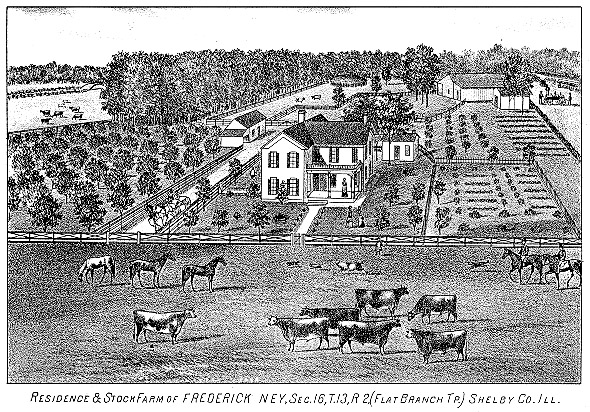
Reuben Denton was one of the first settlers on the west side of the Branch. He first located on section 16, where F. Ney now lives. He began this improvement about 1847.

William Howse improved the place now owned by J. F. Scribner, on the west side of the Branch, in section 22, in 1847. He was a brother of James and Edward Howse.

John Sims, another old resident of Flat Branch, lives on section 27, where he is engaged in farming. First Land Entries were made by the following persons; -- April 3d, 1832, John Armstrong, w. 1/2 s.e. 1/4. 1, 80; February 9th, 1833, Elias Armstro ng, s.e. 1/4, s.e. 1/4 11, 40; February 9th, 1833, Eliza Armstrong, n.w. 1/4, s.w. 1/4, 12, 40.

The first improvement made on what is now the Duncan place, on section four, was made by Jeremiah Campbell about the year 1840. He came here from Sangamon county, Illinois, where he had previously lived. He is a brother of Hon. A. C. Campbell, of Moawequa . Denton's was the second house erected west of Gordon's creek. Michael Thornton built the first house about half a mile south of where the Baptist church now stands.

First School-house and early Teachers. -- The first school-house in Flat Branch was erected in 1833. It was a small structure, built of rough, unhewn, round logs, and stood in the centre of section 12. Daniel Simon was the first teacher, and a Mr. Rodman was the second. This school-house was soon after burned down, and then a hewed log one was put up in its place. It was, also, burned after doing service for several years.

The first, and only post-office in Flat Branch was established in 1851, at the store of Captain A. C. Campbell, on section 4. He was also post-master. The office was named Flat Branch. He ran the office about two years, and when the office at Moawequa was established, that one was discontinued. This township is well supplied with schools and churches. The Baptist church, situated on section 24, is called Little Flock church. The church on the south west corner of section 26 belongs to the Presbyterian den omination. That edifice is a handsome brick structure, and was erected about four years ago. The German Methodists have a frame church which was built on P.P. Ludwig's farm in 1878.

Supervisors. -- G. T. Hutchinson, elected in 1860, re-elected in 1861, 1862, 1863, 1864, and 1865; B. W. Kirkman, elected in 1866; James Howse, elected in 1867; A. W. Drake, elected in 1868; F. P. Snell, elected in 1869; W. C. Miller, elected in 18 70, re-elected in 1871, 1872, and 1873; W. Chadwick, elected in 1874, re-elected in 1875; G. W. Sims, elected in 1876; W. O. Robertson, elected in 1877, re-elected in 1878, 1879, and 1880, and is the present incumbent.

Page 282
BIOGRAPHICAL SKETCHES.

GEORGE HODKINSON.

LIKE many of the progressive farmers of Shelby county, Mr. Hodkinson is an Englishman by birth. He was born in Derbysbire, England, on the twenty-first of April, 1887. He was the third of a family of six children of George and Fannie Hodkinson. His father was a farmer, and for several years in England also served as constable. When Mr. Hodkinson was about four years old, his father emigrated with the family to America. Although then of only tender years, he remembers distinctly the passage across t he Atlantic, particularly a terrible storm that occurred during the voyage and threatened the crew and passengers with a watery grave. Landing in New York, the family came directly to Scott county, Illinois, and settled near Winchester. When he was eight years old, the death of his father resulted from an accident. While engaged in hauling rails, he was thrown from the wagon and run over. His mother was so affected by the unfortunate death of her husband, that she died a short time afterward. The children , all of whom were young, were thus left to take care of themselves. Mr. Hodkinson was apprenticed to a farmer in Scott county. It was agreed that his apprenticeship should last till he became of age, but a circumstance occurred when he was eighteen which brought it to a close, and he afterward worked on a farm on his own account. It was arranged when he entered into the apprenticeship, that he should receive so much schooling, but his employer kept him at work so that he had no opportunity to attend scho ol except on bad days. He afterward went to school one winter, and gained considerable education by his own unaided industry. He was married on the twenty-first of January, 1864, to Maria E. Coultas, who was born on the first of December, 1844, the daught er of Thomas Coultas, and his wife Jane, whose maiden name was Green. Her parents were both natives of England. Her father came to this country when a boy. He settled at an early date in Scott county, living in a little log house, and putting up with grea t inconveniences, that part of the state then being new and unsettled. Mrs. Hodkinson was the oldest of ten children, and was born in Scott county. Her father is still living in that county four or five miles north of Winchester. After their marriage Mr. and Mrs. Hodkinson lived awhile in Scott county, and then moved to Logan county, where they resided eight years, and in 1874 moved on their present farm in Flat Branch township. This farm is well improved, and at one time was considered one of the best fa rms in Shelby county.

They have six children living. Their names are: Sarah Luella, William Thomas, Fanny Jane, Annie May, James Henry and George Wilber. Robert Roy, the next to the youngest child, died in infancy. Mr. Hodkinson was brought up to believe in the doctrines of th e democratic party, and cast his first vote for President for Douglas, in 1860. He became a republican during the war, voted for Lincoln in 1864, and has since acted with the republican party. He is a man who stands well in the township. He was at one tim e elected justice of the peace, but was never qualified nor performed the duties of the office.

WILLIAM. J. SNYDER

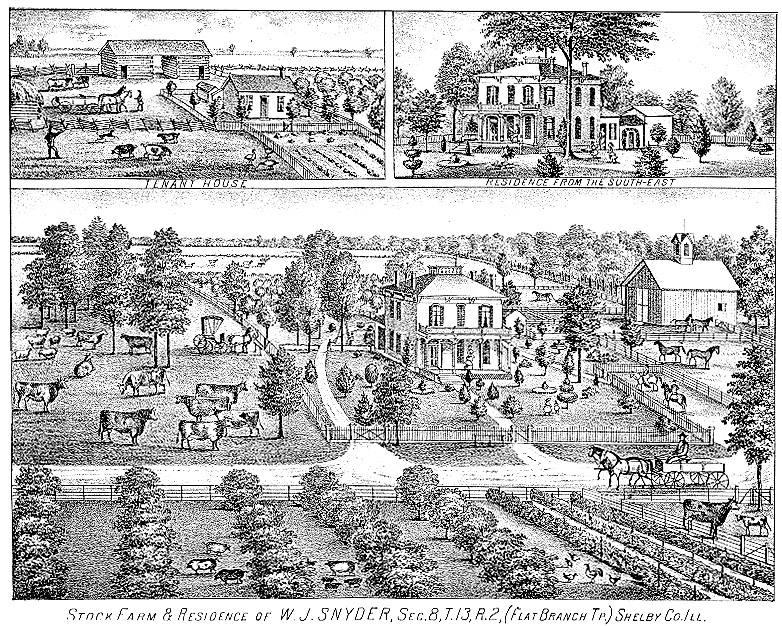
WAS born in Prairieton township, Christian county, half a mile west of Moawequa, on the 28th of May, 1842. He was the fourth of eight children of Michael Snyder and Margaret Kautz. His parents were early settlers of that part of Christian county. H e was raised in the same neighborhood. He secured the elements of a good education in the common schools, and for one year was a student in a seminary at Mt. Zion, Macon county. He left school in the spring of 1861, the year of the commencement of the reb ellion. In June, 1862, he enlisted in Co. L., of the One Hundred and Sixteenth Illinois Infantry. The company was commanded by Capt. J. L. Dobson, and the regiment by Col. Tupper. During his service the regiment was with Sherman and Grant in Tennessee and Mississippi. Toward the latter part of January, 1863, he was taken sick, and after being an inmate of the hospital at Memphis nine weeks, was discharged on account of disability in March, 1863. Having regained his health he re-enlisted at Buffalo, New Yo rk, about the 1st of May, 1864, in the Thirteenth New York Heavy Artillery. He served on the United States steamer Parkes till the close of the war. He was first on the James river in Virginia, and took part in the battle of Petersburg, in the summer of 1 864. The steamer afterward went to North Carolina and took part in the celebrated attack on Fort Fisher. Returning to the James river the steamer was on duty there for a time, and then went to the Neuse river in North Carolina, where it remained till the close of the war. He was discharged on the 4th of June, 1865, and mustered out at Hart's Island, New York City, on the succeeding 4th of July. He then returned to Christian county. On the 17th of October, 1867, he was married to Eliza Ann Gwinner, a nativ e of Brown county, Ohio, daughter of Frederick and Charlotte Gwinner. November of the same year he moved to his present farm in Section 8 of Flat Branch township, where he has since carried on agricultural operations. He has a farm of 360 acres, the impro vements on which are among the best in the northern part of the county. He has four children: Louella May, Ernest Frederick, Mabel Clare and Wil-

Page 283


liam Rutherford. He was originally a republican in politics. His first vote for President was cast for Abraham Lincoln, in 1864, at Newbern, North Carolina, while he was in the army. He remained a Republican till he came to believe that the principles of that organization in reference to the finances and currency were at variance with the interests of the masses, and since has been a strong supporter of the principles of the National Greenback party. Since 1868, he has been a member of the Methodist Episc opal Church. An illustration of his residence is given on another page.

WILLIAM C. MILLER.

FORMERLY county treasurer of Shelby county, is a native of the county, and was born on Robinson Creek, in Ridge township, on the sixteenth of February, 1842. He was the fifth of nine children of Christopher P. Miller and Catharine Speers. His fathe r was married in Fairfield County, Ohio, moved to Shelby county about 1840 and settled in Ridge township, where he still resides. Mr. Miller was raised in Ridge township. He received his elementary education in the common schools. The first school which h e attended in the Robinson creek timber was held in a log school-house with slab benches, a writing desk, which extended along one side of the room, and a large fire-place, which occupied almost the entire end of the building,. When in his twenty-second y ear (on the third of September, 1863) he met with an accident, which resulted in the loss of his right arm just above the elbow. He at once determined to secure a more thorough education, and in the fall of 1863, before his arm was entirely healed, entere d the seminary at Shelbyville, which he attended one year. In January, 1865, he took charge of a school in Flat Branch township. As soon as the term was out he became teacher of another in Ridge township, in the neighborhood of where he was born and raise d. He afterward taught two months in Assumption, and then went back to Ridge township; he put in the time so closely that in the first twelve months he was engaged in teaching he taught twelve school months and two weeks beside. He taught several winters afterward in Ridge, Flat Branch and Tower Hill townships. It is needless to say that he made a good record as a successful and popular teacher. In the summer he engaged in raising hedge plants, a business which he prosecuted with industry and energy, and with profitable results for eight years. He was married on the thirteenth of July, 1871, to Mary Chadwick, daughter of William Chadwick. She was born in Flat Branch township. The first land which Mr. Miller purchased was in Flat Branch township, and he ha d been a resident of that part of the county some years previous to his marriage. After he was married he moved on a farm in section thirty-three.

In the summer of 1873 he was nominated by a convention held at Shelbyville, and composed of the supporters of the Farmers' Movement, as county treasurer. No other candidate was named in opposition, and he was of course elected. After filling the office tw o years he was again a candidate on the People's ticket in opposition to the regular democratic nominee. He received a flattering vote and overcame the usual heavy democratic majority, receiving sixty-six votes more than his opponent. He discharged his du ties as county treasurer in a very faithful and satisfactory manner, and in the fall of 1877, at the close of his second term, moved to his present farm, section twenty-four, Flat Branch township. He is engaged in farming and trading in stock. He has an e xcellent capacity for business, and has always had an inclination for trade and speculation, in which he has been uniformly successful. He is the owner of four hundred and ten acres of land. The death of his wife occurred on the tenth of June, 1878. He h as had three children, of whom the youngest, Bertie Sylvan, died after its mother's death at the age of nine months. Those living are named Ada May and Charles Cyrus. In his politics he has always been a democrat. He was identified with the Farmers' movem ent at the time it exercised its greatest influence in the county. He has generally voted the democratic ticket in State and national elections, though of late years he has inclined to support the views of the national greenback party on questions of fina nce and currency, and in opposition to monopolies. Mr. Miller is still a comparatively young man, but has made both an energetic business man and a capable public officer. Wherever he is known he is recognized as one of the substantial citizens of the cou nty, while his attractive and genial, personal qualities have made him many friends.

ADDISON G. PIERCE.

ADDISON G. PIERCE, who has been engaged in farming in Flat Branch township since 1865, was born in Fairbanks township, Sullivan county Indiana, on the 10th of June, 1834. He is descended from a South Carolina family. His father, Jesse Pierce, was b orn in South Carolina, and came to Indiana when a small boy. His parents were dead, and he was raised by a man named David Gross, one of the pioneer settlers of Sullivan county, Indiana. On reaching manhood he married Keziah Harris, a native of Ohio. She also came to Indiana at a tender age. Mr. Pierce's parents both died in Indiana. Addison G. Pierce was the seventh of a family of thirteen children. He was raised in Sullivan county. His mother died when he was nine years old, and his father when he was f ifteen, and after that he was obliged to take care of himself, and get along the best he could. In his boyhood the schools were all subscription schools, and he had limited opportunity for acquiring anything more than an ordinary education. He succeeded i n qualifying himself for the transaction of all kinds of business; but this was done mostly by his own efforts. He was married on the 11th of September, 1856, to Lucy Ann Clark, who was born in Turman township, Sullivan county, Indiana, on the 5th of Octo ber, 1832. Her grandfather, Reuben Clark, lived in Saratoga county, New York, and married Agnes McClure, a native of Scotland. Her father, Justus Clark, was born in Saratoga county, New York, and married Sallie Reed, a native of the same county. In the ye ar 1818, Mrs. Pierce's parents emigrated to the west. From Pittsburg they came down the Ohio river in a kind of flat boat of their own construction, and after capsizing two or three times, reached Evansville in safety. In 1820 they settled in Sullivan co unty, Indiana.They were among the pioneer settlers. The county was then full of Indians, and they experienced many inconveniences and hardships. The old house which they first built is still standing in Turman township, Sullivan county, Indiana, four mile s from the Wabash river.

After Mr. Peirce was married he went to farming for himself, and lived in Indiana till 1865, and then moved to Shelby county, Illinois, and settled on section 35, of Flat Branch township. He bought ninety acres of land, on which there was a small improvem ent. He has been living there ever since; he now owns one hundred and fifty acres, and is known as one of the progressive farmers of the township. He has three children now living. Arthur S. was born on the 22d of August, 1859; Reuben Elmer Ellsworth on t he 13th of May, 1866; and Herbert Clark Pierce on the 5th of August, 1874. Two others died in infancy. In his politics he was first a member of the democratic party, and in 1856 vo-

Page 284


ted for James Buchanan for president. He continued to be a democrat till of recent years he became convinced that both of the old parties were wrong on financial issues, and the currency question. He has since supported the National Greenback party, and i n the campaign of 1880, supported James B. Weaver for the presidency. He is a member of the Baptist church. He is a man who stands well as a neighbor and a citizen.

JAMES B. WRIGHT.

ONE of the representative citizens of Flat Branch township, is a native of New York, and was born at Salina, now comprised in the first ward of the city of Syracuse, on the 25th of August, 1821. The family from which he is descended was of Scotch o rigin. His great-grandfather, whose name was Ebenezer Wright, emigrated to America from the Isle of Wight. He settled in Washington county, New York, where the grandfather of the subject of this sketch, also named Ebenezer Wright was born. The family sett led there some years previous to the Revolutionary War, when the colonies were yet subject to the British Crown. On the breaking out of the war of the Revolution his great-grandfather considered that he owed his loyalty to the British Government, and went over to Canada and fought on the British side during the struggle. On the other hand, his two sons, one of whom was Mr. Wright's grandfather enlisted in the American army, and served from the first inauguration of hostilities till the termination of the war. Mr. Wright's great-grandfather was in the force with which the British General Burgoyne invaded the State of New York, and the grandfather and great-uncle were in the opposing American army under the command of Gates. They all took part in the battle of Saratoga, and on the surrender of the British troops the father was found by the sons among the prisoners. Mr. Wright's great-grandfather returned to Canada and settled and died on a tract of land at Windmill Point, which the British Government gave h im for his services during the war.

Amos Wright, the father of the subject of this biography, was born at Kingsbury, Washington county, New York. He left his home when a young man and went to Ohio, then the extreme western frontier. He returned to New York in 1809, and lived in Onondaga cou nty till 1812, when he settled on some land he had purchased in Chautauqua county. He enlisted in the American forces during the war with Great Britain in 1812-14. He was first in the Navy under Commodore Perry, but was subsequently detailed for infantry service, and was at Black Rock, (now the city of Buffalo), when it was burned. After the war was over, he settled in Onondaga county, New York, and was married about the year 1816 to Mary Hud- son, who was born on the shores of Lake Champlain, in the Stat e of New York. She was of English descent. Her parents settled in New York state on their emigration from England. He moved to Illinois in 1839, and settled in Stephenson county where he died in 1869.

The first sixteen years of Mr. Wright's life were spent in Onondoga county, New York. He was the third of a family of seven children. When he was about ten his father moved from Salina to the town of Lysander. That county then was but little improved in c omparison with what it is at the present time. His father became crippled and involved in the payment of some security debts, and in consequence, Mr. Wright had but little opportunity to obtain an education. He was obliged to remain at home and assist wit h the work on the farm. The greater part of his education had been gained by his own efforts. In the year 1827, the family moved to Cattaraugus county, New York, and after being there two years, came to Illinois, and settled at Rock Grove, in Stephenson c ounty, arriving there on the 18th of October. Mr. Wright was eighteen when he came to this state. He made his home with his father till his marriage, which occurred on the first of March, 1850, to Sarah L.Davis, a native of Crawford county, Pennsylvania. Her father, Col. Horatio Davis, moved from Pennsylvania to Illinois in 1838, and settled at Rock Run in Stephenson county. When he settled there, the next post-office was twenty-five miles distant. Six months after his arrival he secured the establishment of the Rock Run post office, of which he had charge for many successive years. He became one of the leading citizens of Stephenson county, and died at Galena in 1850, while on his way to California. Mr. Wright was engaged in farming till the breaking out of the war of the rebellion. On the fourteenth of August, 1862, he enlisted in Co. F, of the Forty-Sixth Illinois Infantry. After his enlisting he was kept on recruiting service in Stephenson county for one hundred and five days, and then joined his regi ment at Camp Hall, Mississippi.

The regiment spent part of the winter of 1862-3, in camp at Moscow, and while there, he was detailed for service in the quartermaster's department. During part of this winter he was unfitted for duty by reason of sickness. In the spring of 1863, the regim ent moved down the Mississippi, and joined Grant's army, which was then investing Vicksburg, and took part in the various movements, which resulted in the capture of that rebel stronghold in July, 1863. After the fall of Vicksburg, he went with his regime nt to Jackson, Mississippi, and assisted in the taking of that place. The regiment was afterward stationed at Natchez, and next assisted in the reduction of Harrisburg, Louisiana. From the latter place he returned to Vicksburg, and went into camp at Camp Cowan on Clear creek, nine miles from town. On the fourth of January, 1864, in company with the great part of his regiment, he re-enlisted for three years in the veteran service. The men were then permitted to return to Illinois on a thirty days furlough. The whole regiment, numbering twenty-one officers, and three hundred and thirty-four enlisted men, left for home on the eleventh of January, 1864, proceeded to Freeport, and on the second of March left that place for the field again. The regiment having been recruited to nine hundred and eighty-seven men, they went into camp at Camp Hebron, ten miles east of Vicksburg, and were placed in the Second Brigade, Fourth Division of the Seventeenth Army Corps . The regiment afterward performed garrison duty at Vicksburg till the fourth of May, and then started on an expedition to Yazoo city. On the thirteenth of July, 1864, they went to Jackson, Mississippi, and took part in the engagement at that place; the loss of the regiment being forty-five, the wounded fa lling into the hands of the enemy. At Morganza Bend, the regiment was placed in the First Brigade, Second Division, Nineteenth Army Corps. The regiment left Morganza Bend for White River in September, 1864; then went to Duvall's Bluff, Arkansas, and reach ed Memphis on the twenty-eighth of November. In December, 1864, the regiment was organized in the Veteran Reserve Corps, and placed in the Second Brigade. Remaining in the vicinity of Memphis till the thirty-first of December, 1864, they then left for Lou isiana, arriving at Kennerville, on the second of January, 1865. On the seventh of February, they left for Alabama, and proceeded to Fort Gaines on Dauphin Island. Here the regiment was again recruited to nine hundred and twenty-two men. The Reserve Corps was re-organized into the Thirteenth Army Corps under the command of Gen. Gordon Granger, and the Forty sixth Illinois was placed in the Second Brigade of the First Division. The regiment marched on Mobile, and on the twenty-second of March, 1865, invest ed Spanish Fort, which was captured the following eighth of April. The next day

Page 285


they assisted in the attack on Fort Blakeley, which was captured in one of the finest charges made during the whole war. The siege of Fort Blakely was the last important engagement during the rebellion. On the twelfth of April, the regiment went into camp at Mobile, and on the twenty-seventh of May, left for New Orleans, went into camp near that city, and then went to Alexandria. At Shreveport, Louisiana, they were part of the Union force which received the surrender of Gen. Kirby Smith. They next camped at Salubrity Springs, on an old camping ground, which originally had been used by Gen. Taylor, while marching his army to Mexico, during the Mexican war. On the twenty-seventh of December, 1865, the regiment was ordered to Baton Rouge; were mustered out o n the twentieth of January, 1866; arrived at Camp Butler, Springfield, on the twenty-seventh of January, where the men were discharged on the first of February, 1866. During the service over seventeen hundred men had been members of the regiment. Its line of march and travel extended over ten thousand miles. Mr. Wright enlisted as a private. He was appointed quartermaster's sergeant, and transferred to the noncommissioned staff on the first of March, 1864. He was commissioned as quartermaster on the fifth of October, 1864, and served in that capacity till he was mustered out of the service. While at Natchitoches, Louisiana, he acted as post-quartermaster, and post commandant. His wife's brother, Col. John A. Davis, commanded the regiment at the beginning of the war. He was wounded at Shiloh and died on the tenth of October, 1862, at Bolivar, Tennessee, from wounds received at the battle of Matamora, on the preceding fifth of October.

After his discharge from the service, Mr. Wright returned to Stephenson county. In 1870, he moved to his present farm, section thirty-three, Flat Branch township. He is one of the large and influential farmers of Flat Branch township. He has four children : J. Wright, who is farming for himself in Flat Branch township; Frank, Charlie and Lottie D. The three youngest are living at home. In his politics he has always been an earnest and consistent democrat. He voted for James K. Polk in 1844, and has voted for every democratic candidate since, except when absent in the army. He has a strong and abiding faith in the principles of democracy, and believes the party of which Jackson and Jefferson were illustrious members, is the organization into whose hands th e government of this country should be interested. He believes in restraining, as far as possible, the appointing power of the executive, making all offices outside the cabinet elective. He is a liberal thinker in religious matters. His creed is honesty t o one's neighbor, charity to mankind, and the sacred fulfillment of personal obligations. His name deserves a place in this book, as one of the representative men of the western part of the county.

RUFUS DE GARMO.

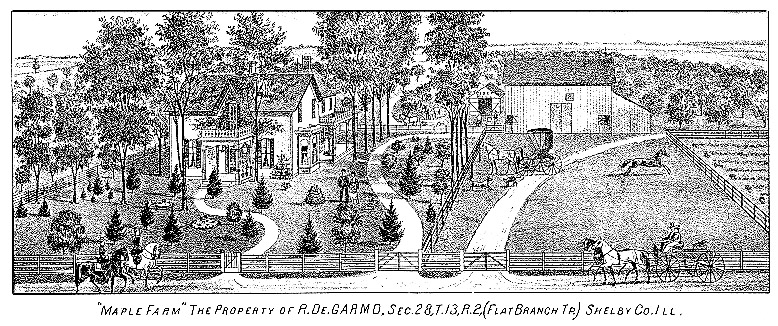
THIS gentleman, a view of whose residence, in Flat Branch township, appears on another page, is a native of New York state, and was born near Esopus, in Ulster county, on the 1st of November, 1821. He is of French descent. His great-grandfather, in company with two brothers, emigrated from France to America at the time of the Huguenot persecution. He settled in New York city. He was killed in one of the engagements of the French and Indian war. Peter DeGarmo, the grandfather of the subject of this sketch, was a resident of New York, and his father, Elias De Garmo, was born in Dutchess county of that state. Both his father and grandfather were members of the denomination of Friends. Mr. De Garmo's mother was Clemma Powell. Soon after his birth his p arents removed from Ulster to Dutchess county, where they lived till 1833, settled near Rochester, New York, where both died. Mr. De Garmo was twelve years of age when the family moved to the vicinity of Rochester. His education was principally attained a t academies at Waterloo, Seneca county, and Alexandria, Genesee county, New York. In 1844, when twenty-three, he emigrated to the west and settled at Sterling, Whiteside county, Illinois. August 25th, 1847, he married Laura M. Miller, whose death occurred in the spring of 1851. She was a native of the state of New York. From 1847 to 1852 he lived in Wisconsin. The latter year he resided in Whiteside county. From 1853 to 1857 he filled the office of county clerk of Whiteside county. In the spring of 1861 h e removed to St. Clair county. In the fall of 1864 he volunteered in the one hundred and forty-ninth Illinois regiment. He was placed on the noncommissioned staff and acted as quartermaster's sergeant during his service. His regiment was principally in Ge orgia. He was mustered out in February, 1866. After his return from the army he moved to Shelby county and settled on land purchased from the Illinois Central railroad company, in section 28, Flat Branch township. At that time there were few improvements in that vicinity. On the 13th of March, 1854, he married Lavinia F. Miles, a native of Susquehanna county, Pennsylvania. Her father, Joshua Miles, emigrated from Pennsylvania to Whiteside county, Illinois, in 1843. He has four children living, all but the oldest by his second marriage. They are Charles, now a teacher in the Illinois Normal Institute, at Normal, Illinois; Caroline ; Alice L. ; and Lidia De Garmo. He was brought up to believe in the doctrines of the democratic party, but was an early anti- slavery man, and became a republican on the first formation of that organization. He has been one of the strong supporters of the republican party in Flat Branch township, and voted that ticket when there were but few republican votes cast in that part of the county.

A. LANSON OSBORN.

MR. OSBORN, a farmer of Flat Branch township, was born in Athens county, Ohio, August 15th, 1822. His grandfather, Josiah Osborn, was born on Long Island, and took part in the battle of Bunker Hill. His father, Moses Osborn, was born in Connecticut , and in New York State married Judith Francis as his second wife, who was born on the island of Guernsey, and came to America when fifteen years old. From New York city he moved to near Buffalo, and about 1818 to Athens county, Ohio, then a new country, where for a small sum he had bought a land grant. In October, 1826, he moved to the north-eastern part of Sangamon county, Illinois, and in 1827 to Greene county, six miles north-west of Carrollton. He was a Methodist preacher. He died in 1858, and his wi fe in 1879. Mr. Osborn was in his fifth year when he came to Illinois. He was principally raised in Greene county; he obtained his education in the old-fashioned subscription schools; most of it he got by himself. He was married February 25th, 1850, to El izabeth Pruitt, daughter of James R. and Mahala (Ambrose) Pruitt, who was born in Green county. The Pruitt family lived in Madison county, near Wood river, at the time of the Wood river massacre, near the vicinity where a woman and two children were kille d. Her grandfather, Major William Pruitt, was one of the Madison county rangers. In the fall of 1850, Mr. Osborn moved near Fidelity, in Jersey county, and in 1855 to Gillespie, in Macoupin county, where he sold goods several months, and then went to farm ing at Dry Point. In 1865 he settled on his present farm in section 18, Flat Branch township. He owns 200 acres

Page 286
of land, and has given some to his children. His children are James Alfred, Richard Francis, Mrs. Mary Virginia Haverfield, Mrs. Nettie Caroline Manley, Lewis Wayland, and Luther Andrew. He was first a whig, and voted for Henry Clay, in 1844. He voted for Lincoln, in 1860, and has since been a republican. For almost forty years he has been a member of the Methodist Protestant church. He has been a good citizen, opposed to every shape of aristocracy and empire, and believes that the people should rule inst ead of pope, priest, or king.

WILLIAM R. CLARK.

WAS born in Warren county, Ohio, on the 26th of February, 1803. His father, William Clark, was born in Virginia, and died a short time after the birth of the subject of this sketch. His mother, Rachel Ross, was born in Kentucky, and was the daughte r of Jonathan Ross, who was born in Maryland, served in the Revolutionary war, and afterwards emigrated to Kentucky, and was one of the pioneer settlers of that state. He assisted in building the block house on the Ohio at Newport, opposite Cincinnati. He was in Cincinnati when that place was composed of only four houses. He afterward settled in Warren county, Ohio, thirty miles east of Cincinnati, where he died about the year 1841, at the age of one hundred and four. William R. Clark was raised in Warren county, on the banks of the Miami river, four miles from Lebanon, the county seat. In the time of his boyhood but little attention was paid to education, and he went to school but little. As soon as he became old enough he was obliged to work, and his gr andfather, with whom he lived, being crippled, he had charge of the farm at an early age. He was married on the 19th of December, 1824, to Nancy Burger, who was born in Virginia, on the 15th of September, 1806. He was employed several years in teaming bet ween the Miami river and Cincinnati. He afterward went to farming for himself on rented land. The Miami valley was very rich and productive, and land being held very high, he determined to come to Illinois where he could secure land of his own. He came to Flat Branch township, in 1854, first settled on the prairie north of the timber, and in the fall of the same year settled on the eighty acres where he now lives, which he had entered at two dollars and a half an acre. He built the first house on the prai rie in Flat Branch township between the timber and the railroad. He had no idea at that time that the country would be settled as it is at present. He has nine children living: Rebecca, Rachel, Mary Ann, Matilda Eliza, James, William, John, Jasper and Emo ry. He has always been a Democrat in politics. He voted for Jackson for President in 1824, and has voted for every Democratic Presidential candidate from that time to the present.

DAVID MIDDLETON.

SQUIRE MIDDLETON, one of the residents of Flat Branch township was born in Allegheny county, Maryland, on the second of November, 1811. His father, Ignatius Middleton, was born at Alexandria, Virginia, and his mother, Sarah Lewman, near Cumberland, Maryland. His grandfather, Hugh Middleton, was soldier in the war of the Revolution. The subject of this sketch was the ninth of a family of thirteen children. He was raised in Allegheny county, Maryland, four miles east of Cumberland.

There were no free schools in his boyhood. He had about two years steady schooling in the neighborhood where he lived, but from the time he was fourteen, he was kept at home to work on the farm, and had no opportunity to attend school. He mastered the rud iments of an education, and improved greatly by self-study. He has always been a great reader.

Among other books he has been a diligent student of the Sacred Scriptures, which he has read through seven times. After his removal to Ohio he taught school. In 1828, the family moved to Ohio, and settled seven miles from Cadiz in Harrison county. Squire Middleton was then seventeen. On the first of November, 1832, he married Hester Howse, a native of Harrison county, Ohio. The next day he was twenty-one years old, and celebrated the attainment of his majority by casting his vote for Andrew Jackson for Pr esident of the United States. He was engaged at farming, and worked some time at the carpenter business. He afterward moved to Coshocton county, Ohio, and was farming there till the fall of 1816, when he moved to Greene county, Indiana. He soon sold his f arm there and bought a farm on the Wabash river below Vincennes, where he lived two years. In the spring of 1865, he moved to Illinois, and settled first in Rural township, and in 1869 became a resident of Flat Branch township. Six of his fourteen childre n are living. Their names are Thomas, Amos, Ignatius, Henry Whiteman, Mary E. and George. The oldest three are farming for themselves in Rural township, and the others reside at home. He has been a straight-out democrat all his life. He has voted for ever y democratic candidate for President beginning with Jackson in 1832. He still believes with the same earnestness in the principles of the party of Jefferson and Jackson that he did fifty years ago. When in his eighteenth year he united with the Methodist church, with which he was connected for many years. He is now an elder in the Bethany Presbyterian church -- the nearest and most convenient house of worship.. He was elected justice of the peace in the fall of 1869, and served until the spring of 1880, h aving been elected to the office three different times. He is a man who stands well in the estimation of the community. He has lived on terms of good-will with his fellowman. As a justice of the peace, he used all his endeavors to discourage litigation an d promote peace and harmony between neighbors, a course which does credit to the generous sympathies of his nature.

Page 287


|| Return to Main Site Index ||