|
EDEN PREDECESSORS JOHN R. EDEN*
*Combined History of Shelby and Moultre Counties, Philadelphia, 1881, p. 186.
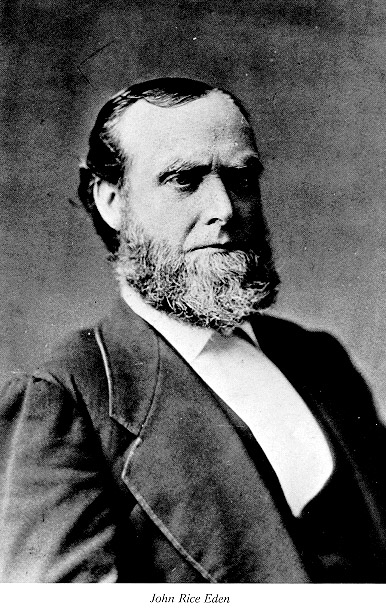
The subject of this sketch was the third of a family of six children. In 1831 when
he was five years old, the family moved to Rush County, Indiana. Four years later
the father died, leaving his family in somewhat limited circumstances. Mr. Eden's
bo
yhood days were spent in Rush County, a rough frontier portion of Indiana, possessing
only the commonest educational facilities. As was the custom with the boys of that
period, he went to school in the winter, and worked on the farm during the summer.
He made the best use he could of his opportunities, and at the age of eighteen, secured
a position as teacher of a school in the same neighborhood where his early years
were spent. He afterward taught school several winters. Rushville, Indiana, and industriously applied himself to his legal studies. After reading law two years at Rushville, he came to Illinois in the spring of 1852, and settled at Shelbyville with a view of establishing himself in practice at that point. He was admitted to the bar in May 1852. He opened an office and was meeting with success in securing business, when the unfavorable condition of his health occasioned his removal in Augu st 1853 to Sullivan, of which place his brother had become a resident. At that time Sullivan was a place of small size and importance. There was only one other lawyer beside himself in Moultrie County, and he was fortunate in getting an excell ent start. He secured the good will and friendship of some of the elder and prominent members of the bar in the neighboring counties, and at their suggestion in 1856, became a candidate for the position of prosecuting attorney for the seventeenth judic ial district, which then comprised the nine counties of Macon, Piatt, Moultrie, Shelby, Effingham, Fayette, Bond, Christian and Montgomery. Previous to this event his acquaintance had been confined mostly to the counties of Moultrie and Shelby. His f our years' service as prosecuting attorney brought him in contact with the people of the different counties composing the district, while the position was one which, of necessity, was of great value in developing his talents as a lawyer. In the trial o f important criminal cases he was frequently opposed by such able lawyers as Linder, Thornton, Moulton and Ficklin, who tested his abilities to the utmost. In his politics he had always been a Democrat, and in 1860 he received the Democratic no mination for representative in the legislature. The District was strongly Republican, and he was defeated by a few votes. In 1862, the Democrats of the seventh congressional distr ict, comprising the counties of Iroquois, Ford, Vermillion, Champaign, Piatt, Macon, Moultrie, Douglas, Edgar, Coles and Cumberland made him their candidate for representative in Congress. These counties in 1860, had given a Republican majority of abo ut sixteen hundred, but Mr. Eden was elected with fourteen hundred votes to spare, and in March 1863 he took his seat in the thirty-eighth Congress. The war of the rebellion was then in progress. The Democratic members of Congress formed only a small minority. He was placed on the Committees on Accounts and Revolutionary Pensions. He supported the measures necessary for the suppression of the rebellion. In 1864, he was re-nominated by the Democrats without opposition, but a Republican wa s returned from the district. He then gave his whole attention to his law practice until 1868, when he was made the Democratic candidate for governor against Palmer. He thoroughly canvassed the state, making speeches in almost every county, but was de feated with the balance of the ticket. In June 1872, though he made no efforts to obtain the nomination, nor was present at the convention, he received the Democratic nomination for representative in Congress in the present fifteenth district. He was elected, and in 1874, and again in 1876, was re-elected. His services in the house are well known to the people of the district he represented. In the Forty-fourth and Forty-fifth Congresses he took a particularly active part in the general b usiness of the house, and the vigor of his opposition to all kinds of subsidies, and the various schemes for depletion of the treasury attracted general attention. During the last four years of his service he was chairman of the Committee on War Claims. This position threw on him a vast amount of labor, the numerous claims which came before the committee requiring the closest scrutiny. He was a member of the special committee appointed by the House of Representatives to investigate the presidential election in 1876, in South Carolina, and with other members of the committee visited that state. Since the expiration of his term as a member of the Congress, he has bee n engaged in the practice of the law in Sullivan and in farming. During the years 1870 and 1871, he was a resident of Decatur. His marriage took place on the seventh of August, 1856, to Roxana Meeker, daughter of Ambrose Meeker. He has five children living. He has always taken an active part in politics, and in every important political campaign since 1856, has been a ready and earnest advocate of the principles of the Democratic party. In his election to important positions he has been honored, but in every instance has justified the confidence placed in his ability and integrity. He has passed through his years of public service without the smell of corruption on his garments and whether a private citizen or in public life has alway s been the same honest, plain and unpretending man of the people.
This is the family Bible of the Eden family -- John Paul Eden (1796-1835) and his
wife, Katheryn Cann Eden (1800-____), who were married November 19, 1819, and who were
the parents of Joseph Edgar Eden (1820--) and John Rice Eden (1826-1909). Two daugh
ters
lived to reach womanhood -- Julina Eden Moore and Nancy Jane Eden Sampson. Julina Eden was born February 26th, 1823. John Rice Eden was born February lst, 1826. Nancy Jane Eden was born August 27th, A.D. 1832. John Eden died July the 16, 1835, was 39 years 2 months and 16 days old. Mary Ann Eden was born August 12th, 1835. Mary Ann Eden died January the 19th, AD. 1842. 2."Fam ily Record" in 1844 Bible. Marriages: John Paul Eden and Katharine Cann was married November the 19th, 1819. Joseph E. Eden and Matilda Burrell was married May the 14th, 1846. Henry B. Sampson and Nancy J. Eden wer e married the 16th August 1852. Henry B. Sampson, died April 5, 1908. Births: John Paul Eden was born April the 30th, 1796. Katharine Cann was born September the 26, 1800. Marilda Sampson was born July 2d, 1853 . Edgar Sampson was born October 29th, 1855. William Sampson was born May 25, 1858. George Sampson, born May 26, 1865. Susan Rice Sampson, was born Decemb er 4, 18_9. Rosie Sampson was born June 29th, 1870, Henry B. Sampson was born February the 7, 1828. Alfred Leroy Sampson was born April 28, 1888. Lilian Sampson was born September 2, 1891. Joseph Edgar Eden was born September the 10th, 1820. Irelina Eden was born February the 26th, 1823. John Rice Eden was born February the lst, 1826. Susan Eden was born January the 21st 1829. Nancy Lane Eden was born August the 27, 1832. Mary Ann Eden was born August the 12th, 1835.
Matilda E. Burrell was born April the 25th, 1828. John Finley Eden was born December the 26th, 1851. Marilda Sampson was born July the 2d, 1853. Deaths: John Paul Eden died July the 16th 1835, aged 39 years, 2 months and 17 days. Mary Ann Eden died January the 19th 1842. S usan Eden died July the 23rd, 1845. Mary Ann Sampson died October ___, ___. MRS. ROXANA EDEN*
*Sullivan Progress news clipping, undated.
in marriage with the already noted young attorney at law, John R. Eden, to whom she was devotedly attached and always anxious to aid in all his aims in life, making for him a model wife fa ithful to all his trusts and whose loss he deeply feels in his lonely and grief-burdened desolation. Eight children blessed their union, of whom five are living, honored and influential members of society, namely: Emma, Rose (Mrs. I.J. Martin), Walte r (county treasurer and mayor of Sullivan), Mabel and Blanche. Three have already passed the dark river, Hartwell, a young man at his death; Joseph Edgar, and Finley R., both in childhood. In the fall of 1866, Mrs. Eden became a member of the church of Christ in Sullivan, Illinois, and ever faithful to its duties keeping sacred its obligations always. She was a woman full of charity and good works, was kind to the poor, courteous and obliging in the relations of life, having a deep and rel ieving sympathy for the sufferings of our race. Her life was such as may well be imitated by all wives and mothers and referred to with pleasure by her children. The funeral was on Sunday, March 11, at 10 o'clock a.m. and was largely attended, all of the churches deferring their usual services for that purpose. A large procession followed the remains to the Sullivan cemetery where she was laid beside her departed loved ones. Dr. A.L. Kellar
*Combined History of Shelby and Moultrie Counties, Philadelphia, 1881, p. 187.
Judge Jonathan Meeker, who has been since 1877 judge of the Moultrie County Court,
is a native of Delaware County, Ohio, and was born on the 25th day of July, 1831.
His father, Ambrose Meeker, was born near Orange, N.J. He was a descendant of a
family
which had settled at an early date in Connecticut, and removed from there to New Jersey.
About the year 1821, he emigrated to Ohio, making the whole journey on foot. At
Newark, Ohio, in 1824, he married Hannah Hartwell, who was born in Plymouth, Mass
.
Through her mother she was connected with the Ripleys, one of the early New England families. three winters, and secured a more thorough education. He learned the blacksmith trade with his father at which he worked till twenty-four or twenty-five years of age. He began the study of the law at Sullivan in 1857, and in 1858 was admitted as a member of the bar. On the 20th of November 1860, he married Nancy, daughter of Robert Parker; she was a resident of Jasper County, Indiana, where the marriage took place. From 1862 t o 1864 he acted as deputy circuit clerk, and had the entire management of the office. In 1864 he was the Democratic candidate for prosecuting attorney for the judicial district comprising Macon, Moultrie and Piatt counties. The district was strongly Republican, and he was defeated by a few votes. In 1867, on the adoption of township organization, he was elected the first member of the board of supervisors from Sullivan township, and the first chairman of the board. He was re -elected in 1868 and 1869, and each term served as chairman. He was also a member of the board in 1876 and 1877. In 1870 he was elected to represent Moultrie County in the twenty-seventh general assembly. This was the first session of the legislature after the a doption of the new state constitution. A revision and remodeling of the laws became necessary, and the legislature was in session the greater part of the time for two years. He was elected county judge in 1877. In addition to the practice of the law , he has been engaged in farming. He has five children. He has been an active Democrat in politics.
12. By Miss Rose Eden
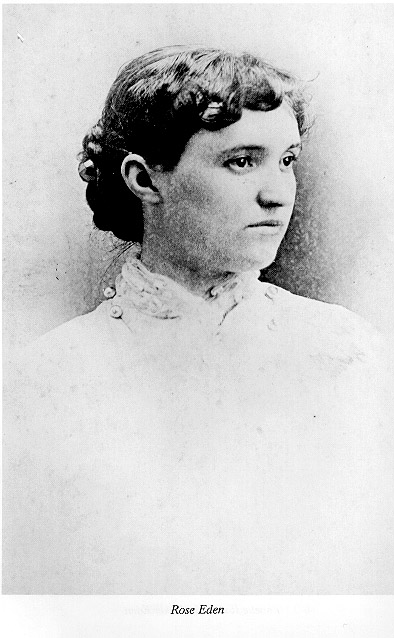
Pause, fleet-winged Time! smile once on mortal's prayer;
Adieu, fair woodlands home -- a long adieu! So from my tear-dimmed gaze will fade thy Cross; Nor golden halo soothe my heart's deep loss, Throbbing mid all its joy with strange unrest. Yet what are these but charms that call to mind The faithful friends long in our hearts enshrined? Soon, some will roam mid Southern orange bloom; Some hear the surging of Atlantic's tide; Others mid Western prairies sweet perfume, Or in the ice-bound Northern climes abide. Companions while we greet our loved ones near, The Past looks back, like vision veiled in mist, On us whose childish brows she oft hath kissed, And passing slow, invites one holy tear. Here have we pored with her o'er History's page, Roamed hand in hand through favored walks of Art. And worshipped all that Science can impart; Here soared on high with Albion's poet-sage, - With honored scions of Columbia tree, - And viewed with pride our nation's jubilee. But these and stronger links today are broken; Classmates -- our last farewell -- it must be spoken! The floral wreath of this remembered day, Like all things earthly, soon must fade away; But friendship, constant, deep, and true as ours, Shall live and bloom amid celestial bowers. Devoted Sisters, thought and language fail! Can feeble thanks reward the dews of Heaven? Can we repay the sun for daylight given? No more could gold or priceless gems avail As offering for your life-long sacrifice. Farewell -- farewell! although today we part, A golden chain which clasps beyond the skies, The chain of prayer and love, still heart to heart Shall bind us all; in joy or grief cast down Teach us to "bear the Cross and win the Crown;" And oft in dreams will rise on sea or land, Our ALMA of Potomac's proud old strand. Stay, fading Hours! I hear your solemn bell - One moment, only one - to breathe farewell! Academy of the Visitation,* Georgetown, D.C., June 27, 1879 *Rose Eden attended the Academy of the Visitation when her father, John R. Eden, was serving in the House of Representatives. A school brochure from that time states that the Georgetown Academy conducted its classes in a handsome, new 3-story building, rebuilt in 1873, and located on the Heights of Georgetown. Tuition and board then amounted to $300 per year. LAMENT FOR THE LOCUST TREE By Miss Rose Eden O thou ill-fated locust tree! We grieve today and check our glee, As by thy form we pass, So lowly on the grass. We hoped beneath thy shade to play Our merry games on summer's day And wreathe our garlands green To deck our May-day queen. But now divested of thy crown, Like some great monarch fallen down, No more the winds will sigh Among thy branches high. The birds that come with gentle spring, On thy green twigs no more will sing; But sigh in passing o'er To see thou art no more. Thy forest by others round thee stand; Why art though fallen by fate's dread hand? Thy branches strewn around - Thy roots torn from the ground. The mosses closely to thee cling; As though they back to life would bring Thy hoary trunk - my throne, As here I muse alone. In earlier years the sweet perfume Of thy green leaves and bounteous bloom, Made this a loved retreat, A bower for childish feet. Full half a hundred years had flown; Thy beauty gone, all withered grown, No more thy branches spread - Thy blossoms fragrance-shed. Upon our hearts like solemn knell, Each stoke of woodman's stem axe fell; So like a human thing Our hearts to thee would cling. Thus shall our lives receive that blow Which broke thy ties on earth below; Then rich in fruit, may all In God's arms gently fall. Academy of the Visitation, Georgetown, D.C. THE RURAL SLEEPER By Miss Rose Eden In a fresh-mown grassy meadow, Dotted o'er with sun and shadow; 'Neath an alcove made of sheaves Loosely clasping flowers and leaves, Rests a sun-browned happy sleeper, Wandered far from busy reaper; Faithful Rover by him lying, Eyes half oped, with look defying; One bare foot o'er grass extended, Flaxen hair with wheat-blades blended; Little hand in trust lies over Shaggy neck of his loved Rover. Wandering all the livelong day Where the lambs o'er prairies play, Now the roamer torn and weary, 'Neath the wheat sheaf sad and dreary, Closed his eyes midst murmuring quiver Wafted from the meadow river; And while breezes chimed their sweetest, Fancied thought on pinions fleetest, Him to realms of magic carried While gay song-birds round him tarried. He is dreaming, little knowing How fond hearts for him are glowing; He is seen by village steeple High above bewildered people, Searching over field and prairie Their lost treasure, who like fairy Safe within his nest is sleeping, Still in dear old Rover's keeping. But his tearful little sister Thinks of how this morn he kissed her; And his saddened elder brother Wonders what he'll say to mother! Led at last to fragrant nook, With what loving eyes they look On their lost one in his bower Dainty formed of sheaf and flower; Hug and kiss the sun-browned sleeper, Pat the head of watchful keeper, And as daylight slowly dies, Homeward lead their little prize. Academy of the Visitation, Georgetown, D.C. |
